
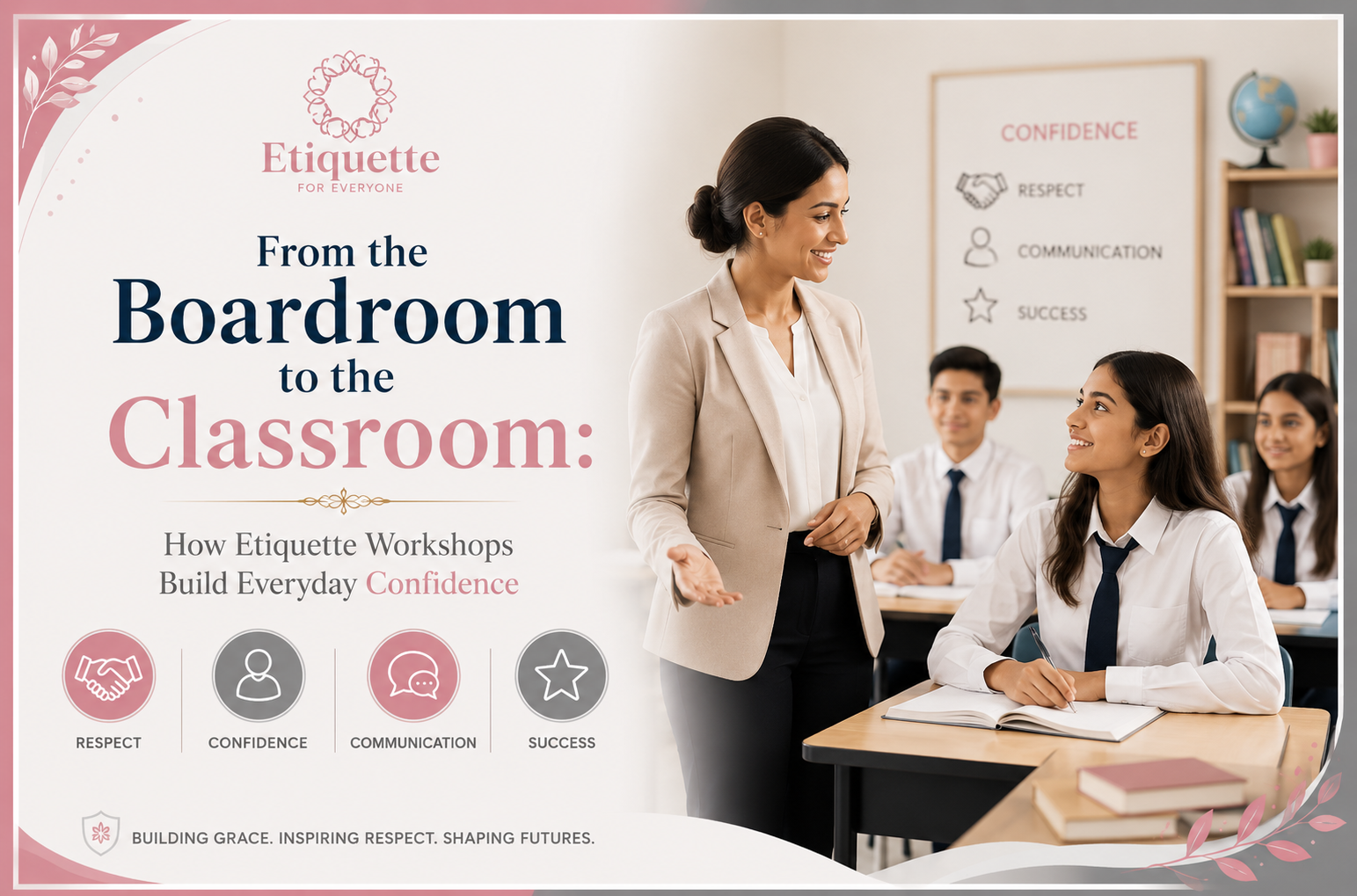
From the Boardroom to the Classroom: How Etiquette Workshops Build Everyday Confidence
Etiquette has to do with formal dinners, corporate meetings, and which fork to use during a dinner. In real life, it is much easier than that. It is knowing how to introduce yourself when meeting someone new. It has to do with listening without interrupting. It has to do with knowing how to conduct oneself in a room, how to talk to a person who is older than you, and how to manage difficult social situations with ease.
This skill can be helpful not only to adults but also to children. In Dubai, where people of different cultural backgrounds meet on a daily basis, such a skill as learning how to communicate in a respectful manner is very helpful. Corporate Etiquette Workshops teach adults practical skills needed in corporate and social environments, whereas an Etiquette Workshop for Kids can give children knowledge about such behaviour. For those families who seek some structured learning apart from school, an After school activity workshop Dubai may come in handy.
Why Corporate Etiquette Workshops Matter
The professional environment is not all about knowing the particular skills required for one’s job. There should be an understanding of how employees should conduct themselves, interact and present themselves. These aspects may be practised during Corporate Etiquette Workshops. Such a workshop may deal with the following issues:
- Professional introductions
- Communication at the workplace
- Etiquette at meetings
- Business dinners
- Networking
- Phone and email etiquette
- Body language
- Personal presentation
- Cultural diversity
- Difficult social situations
A Real-Life Workplace Example
Think about a newly hired employee who attends their first meeting with a valued client. The employee is knowledgeable regarding the products of the company; however, the individual interrupts the client more than once, uses his mobile while having a conversation with the client, and even starts eating before other people do at lunchtime.
Perhaps it was unintentional for the individual to give the impression that he or she is being disrespectful. The problem could be caused by the fact that the individual was not taught how to behave. A practical etiquette training can use such a scenario and conduct an educational activity for the trainees.
Read More: The Complete Guide to Etiquette Classes: Skills, Benefits & Best Programs
Etiquette Is About More Than Business
Even though corporate etiquette may seem applicable only to professional environments, one should understand that the same skills are useful in day-to-day communication as well.
Think about a simple dialogue taking place between two people.
One of them keeps looking at his/her phone when the other one is talking. Even though there were no disrespectful words exchanged, the latter may feel ignored.
Imagine the same dialogue without a phone and with eye contact and active listening from the other side.
There is only a slight change in terms of details, but the whole feeling of the communication is entirely different.
Why Teach Etiquette to Children?
Social behaviour is learned by children through observation and practice. They observe the way adults speak and learn how to form their social behaviour. An Etiquette Workshop for kids can provide them with a safe place to practice all these skills.
According to the age of the children, various activities can be organised, such as:
- Introduction to people
- Greetings
- Taking turns during communication
- Listening without interrupting
- Use of polite language
- Manners at the table
- Expressing gratitude
- Respecting personal space
- Disagreement handling
- Good sportsmanship
- Appropriate behaviour in public places
The idea is not to make children too formal. Children learn how small things can help them socialise with other people.
A Real-Life Example: The Birthday Party
Consider the case of a child participating in a birthday party. He comes and starts playing without even greeting the host. After that, he opens someone else’s birthday gift without being allowed to do so. He leaves without even saying thanks when the party ends.
- The child does not have any idea about the significance of such behaviours.
- The workshop can turn the same case into a role-play exercise for the children.
- The children will play the same scenario twice:
- First time: They perform as per their nature.
- Second time: They learn how to greet the host, how to wait for their turn, how to respect others’ gifts, and how to say thanks.
The children will be able to realise the difference between both scenarios.
What Can Children Learn Through an After-School Etiquette Workshop?
An After school activity workshop Dubai can provide children with structured learning after their regular school hours. As opposed to teaching academics only, after-school activities can teach practical social skills to children.
- Communication Skills: Children can learn to communicate effectively, introduce themselves, and speak politely.
- Listening Skills: The activities will enable children to learn how to listen to the speaker and wait for their turn.
- Table Manners: The activities will help children learn basic manners such as sitting correctly, eating correctly, and being considerate of others.
- Confidence: Through role play, children will have chances to practice situations that they do not know how to handle.
- Respect and Consideration: Children will learn how their behaviour affects their friends, family members, teachers, and other individuals around them.
Making Etiquette Fun for Children
Children learn better through participation rather than listening. Some of the activities that can be included in the Etiquette Workshop for Kids include the following:
Role Playing
This includes children acting out:
- Meeting a stranger for the first time
- Dinner in the family
- Going to a friend’s house
- Interacting with a teacher
- Ordering food in a restaurant
- Joining a group
“What Would You Do?” Scenarios
- Here, the instructor will describe a scenario and tell the kids how they can react to it.
- Examples of scenarios include:
- Your friend is talking to you, but you want to look at your mobile. How can you manage?
- Various options can be considered, and then they can figure out which behaviour is more considerate.
Corporate Workshops vs. Kids’ Etiquette Workshops
Even though both types of workshops deal with social skills, they need to take different approaches.
| Corporate Etiquette Workshops | Etiquette Workshop for Kids |
| Focus on work-related issues | Focus on social interaction issues |
| Cover meetings and networking | Cover schools, family and other social interactions |
| May include business dining etiquette | May include table manners |
| Focus on professional communication | Focus on respectful communication |
| Include role play in workplace settings | Include age-appropriate games |
| Help build professional confidence | Help build social confidence |
The same basic principle connects both: people learn etiquette by understanding, practising, and applying appropriate behaviour.
Why Dubai Makes Etiquette Skills Especially Relevant
Dubai culture brings together individuals from many nations and diverse cultures.
- A child could grow up going to an international school, taking part in events with kids from other cultures, and interacting with people of different cultures.
- An adult is in a similar position when in a working environment.
- Flexibility and cultural awareness are thus key to the individual’s success.
It should not be assumed that etiquette entails adherence to the same customs.
How Parents Can Reinforce Etiquette at Home
A workshop can provide new skills, but children will derive the most out of the process by using these skills consistently.
Etiquette can be taught to children using common, daily instances.
For instance,
- Instruct the children to welcome their visitors.
- Ask them to thank the people who help them.
- Instruct them to introduce themselves.
- Tell them not to interrupt while others speak.
- Teach them to respect the possessions of other people.
- Make the children take part in tasks like setting the table.
- Discuss how some instances call for different behaviours from others.
The goal is consistency rather than perfection.
How Adults Can Reinforce Etiquette at Work
Professional people can also cultivate good habits in their day-to-day life. Some of these habits include:
- Putting your cell phone aside when you have an important conversation.
- Being prepared for a meeting.
- Introducing two people who don’t know each other.
- Listening before you speak.
- Respecting other people’s ways of communicating.
- Expressing your gratitude for your co-workers’ assistance.
- Keeping any professional differences friendly.
- Thinking about the cultural background of people before assuming anything.
Small habits can gradually become part of your natural professional behaviour.
Choosing the Right Etiquette Workshop
Before joining the workshop, ask yourself or your kid: what do you really need?
For kids, search for:
- Age-appropriate exercises
- Interactive teaching
- Role-playing
- Group work
- Examples
- Feedback
For corporate groups, include:
- Relevant for industry
- Format of the workshop
- Real-life situations
- Practice chances
- Awareness of culture
- Customised material
The workshop must seem relevant to the lives of those who join it instead of being a mere listing of do’s and don’ts.
Frequently Asked Questions
What are Corporate Etiquette Workshops?
Corporate Etiquette Workshops provide the practical etiquette rules that are needed in professional settings, such as communication, meeting protocol, networking, business dining, personal presentation, and workplace interactions.
What is an Etiquette Workshop for Kids?
Etiquette Workshop for Kids provides children with an age-appropriate understanding of proper social conduct using activities, games, role play, and realistic situations.
What can children learn in an after-school etiquette workshop?
Kids can learn communication, listening, greetings, table manners, respect, confidence, and social awareness.
Are etiquette workshops only about table manners?
No, because modern etiquette programs can include communication, body language, introductions, social behaviour, professional behaviour, cultural awareness, and basic manners.
How can parents teach etiquette at home?
Parents can demonstrate proper social conduct and allow children to practice greetings, listening, saying thank you, taking turns, and courtesy.
Conclusion
Etiquette does not have to seem rigid or complex. It simply involves teaching one how to behave towards others appropriately and confidently. For professionals, the Corporate Etiquette Workshops are able to use some routine corporate settings as tools for skill enhancement. When it comes to kids, it can be helpful to attend the Etiquette Workshop for Kids to learn all necessary social skills through games and role-playing.
An After school activity workshop in Dubai can also give children a structured environment where they can practise these skills outside the classroom. Whether the setting is a boardroom, restaurant, school, birthday party, or family gathering, the same lesson applies: small acts of consideration can make everyday interactions easier and more positive.